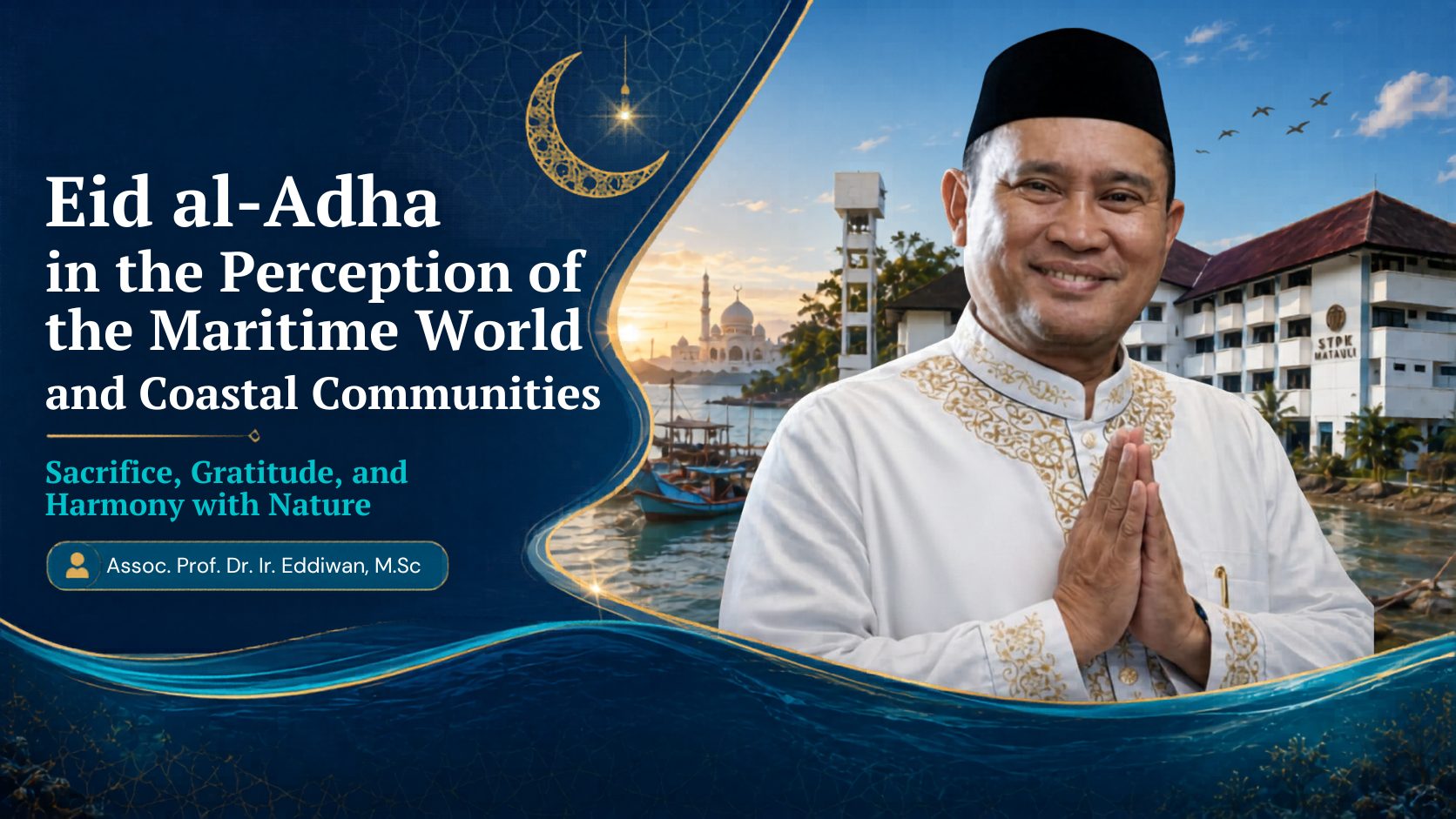
Eid al-Adha in the Perception of the Maritime World and Coastal Communities: Sacrifice, Gratitude, and Harmony with Nature
By: Assoc. Prof. Dr. Ir. Eddiwan, M.Sc
College of Fisheries and Marine Science of Matauli
Pandan, Central Tapanuli District.
In an archipelago surrounded by sea for more than two-thirds of its territory, Eid al-Adha is more than just an ordinary religious celebration. For the maritime world and coastal communities, this occasion has a much deeper meaning, entwined with their way of life, culture, local knowledge, and their close relationship with the sea as their primary source of life. The values of sacrifice, obedience, and sharing, which are at the heart of Eid al-Adha, have undergone unique interpretations and adaptations, rooted in life experiences confronting the forces of nature and dependence on maritime resources.
Basic Meaning: Sacrifice and Attachment to the Creator
The core teachings of Eid al-Adha center on the story of Prophet Ibrahim (peace be upon him), who was willing to sacrifice his son, Prophet Ismail (peace be upon him), to obey Allah’s command, ultimately offering a sacrificial animal as proof of his accepted obedience. The key values here are sincerity, letting go of attachments to what is loved, and absolute devotion to the Creator.
According to Muhammad Yusuf, an expert in Islamic and environmental studies, the meaning of sacrifice does not stop at slaughtering an animal, but rather symbolizes complete surrender and recognition that everything in the universe, including the sea and all its contents, belongs to God, for which we must be grateful and manage it well. From this perspective, coastal communities understand that their lives, which depend on the waves and wind, also represent a form of obedience and trust that sustenance will come according to His will.
Value Adjustment: Sacrifice as a Way of Life at Sea
For coastal communities, the concept of sacrifice in Eid al-Adha has a very real and contextual interpretation. Sacrifice has become an inseparable part of their daily lives. A fisherman is willing to leave the comfort of home, be separated from his family, and brave the dangers of the ocean to bring home sustenance. This aligns with the opinion of Dr. Joni Ahmad Mughni, an expert in the sociology of religion, who stated: “For coastal communities, the spirit of sacrifice is a spirit of hard work, a willingness to sacrifice time, energy, and even personal safety for the sake of family survival and community togetherness. This is a concrete manifestation of the meaning of Eid al-Adha, not only observed during the holiday but also experienced every time the anchor is raised and the sails are unfurled.”
The unpredictability of marine conditions also shapes unique religious understandings. In South Sulawesi, for example, it is common to see practices where Eid al-Adha prayers and celebrations are aligned with fishing schedules. When the fishing season arrives and the weather is favorable, fishing activities continue, and worship is carried out in a practical yet solemn manner. According to observations by cultural sociology researchers from Hasanuddin University, this is not a violation, but rather a form of harmonious dialogue between religious obligations and the demands of life derived from nature. “They believe that working for a lawful livelihood at sea is also an act of worship, and steadfastness in facing the risks of the sea is a form of true obedience,” he wrote in his study.
Local Traditions: Eid al-Adha Blended with Maritime Culture
In various coastal regions of Indonesia, Eid al-Adha has developed into a unique tradition that combines Islamic law with local wisdom about the sea. This demonstrates the inclusive and adaptive nature of Islam Nusantara. One of the most striking examples is the Ari Kaut tradition in Lilinta Village, Raja Ampat, West Papua. Here, Eid al-Adha is celebrated by collecting donations from residents to purchase sacrificial animals, accompanied by special prayers offered not only for the blessings of life, but also for the safety of the sea, an abundance of fish, and the preservation of coral reefs. According to research published in the Ar-Raniry Journal of Islamic Studies, this tradition is a form of respect for the fact that their continued survival depends heavily on the health of the marine ecosystem. “For them, making a sacrifice also means promising not to harm the sea, because the sea is a gift from God that must be protected so that it continues to provide sustenance,” the study concluded.
In Maluku, there is the Abdou tradition, a series of post-Eid al-Adha activities in which sacrificial meat is distributed to anchored boats and even to nearby small islands. This reflects the spirit of maritime brotherhood: no neighbor is separated by sea, and sharing is a natural law of communal life. Cultural historian M. Nur Tawainella states that this tradition has been practiced since the arrival of Islamic missionaries who arrived by sea, bringing religious messages that simultaneously strengthened the social bonds of coastal communities.
Prof. Alfurqan, Professor of Islamic Education at Padang State University, emphasized that such practices are evidence of the greatness of Islamic teachings, which have taken root in every environment. “The main values of Eid al-Adha—sharing, caring, and gratitude—are embodied by coastal communities in ways that are in harmony with their environment. They do not abandon their religious teachings, but instead enrich their meaning with the experience of living close to the sea,” he said.
Ecological Dimension: Sacrifice as a Responsibility to Protect the Sea
A deep understanding of dependence on nature makes Eid al-Adha a powerful environmental conservation tradition for coastal communities. If the meaning of sacrifice is acknowledging that everything belongs to God, then the consequence is that we are obligated to protect it and not over-exploit it.
In his Eid al-Adha sermon at Makassar Harbor in 2025, Prof. Muhammad Yusuf emphasized this: “The sharia of sacrifice teaches us not to be greedy. For those of us who live off the sea, this means not taking more fish than the sea can replenish itself, not destroying the mangrove forests that are home to fish, and not polluting the water. Protecting the sea is a form of worship and gratitude for the blessings God has bestowed through these waves.”
This is very much in line with the principles of local knowledge of coastal communities that have existed for centuries, such as the sasi system in Maluku, or the prohibition of fishing in certain areas during certain seasons. Researchers from the Association of Coastal Management Experts (HAPPI) stated that the religious values reinforced during Eid al-Adha serve as an effective moral reminder to maintain the sustainability of marine resources, far more powerful than mere government regulations.
Challenges and Hopes: Strengthening Meaning Amidst Change
However, amidst modernization, marine industrialization, and climate change, the meaning of Eid al-Adha is beginning to face challenges. Changes in lifestyles, the massive introduction of fishing technology, and limited access to fishing grounds due to policies and large asset ownership are slowly eroding the values of togetherness and gratitude that were once so strong.
Buya Amirsyah from the Indonesian Ulema Council (MUI) reminded that the meaning of Eid al-Adha should not be merely ceremonial. “Amidst increasingly fierce competition, including in the maritime sector, the spirit of sacrifice must be rekindled: sharing blessings, helping one another, and being unselfish in exploiting the ocean’s riches. Eid al-Adha should be a moment to reflect: have we shared the ocean’s bounty fairly, and have we safeguarded it so that it will remain for our children and grandchildren?”
Suryono Bintang Samudra, a coastal development practitioner, added that the essence of Eid al-Adha is highly relevant to maritime economic development. “A spirit of sincerity, hard work, and sharing are the main assets for building progress in coastal areas. If these values are implemented in policy, marine development will not only benefit a few but also bring prosperity to all.”
References
Alfurqan. (2026). The Essence of Sacrifice in Cultural Diversity. Asatunews.
Detikcom. (2026). Diverse Eid al-Adha Traditions in Indonesia.
HAPPI. (2026). Religious Values and Coastal Resource Management.
Maritim Indonesia. (2025). Reflection on Eid al-Adha: Spiritual Meaning at the Pier.
Mughni, J. A. (2026). Eid al-Adha: A Social and Economic Driver for the Community. East Priangan News.
Quran, Surah As-Saffat, verses 102–107.
Source:
Tawainella, M. N. (2025). The Abdau Tradition: The Confluence of Sharia and Maritime Culture. Ar-Raniry Journal.
Unhas Sociology of Culture Research Report (2024). Religion and Natural Rhythms on the Coast of South Sulawesi.
Yusuf, M. (2025). Sacrifice and the Obligation to Protect Nature. Maritime Indonesia Journal.