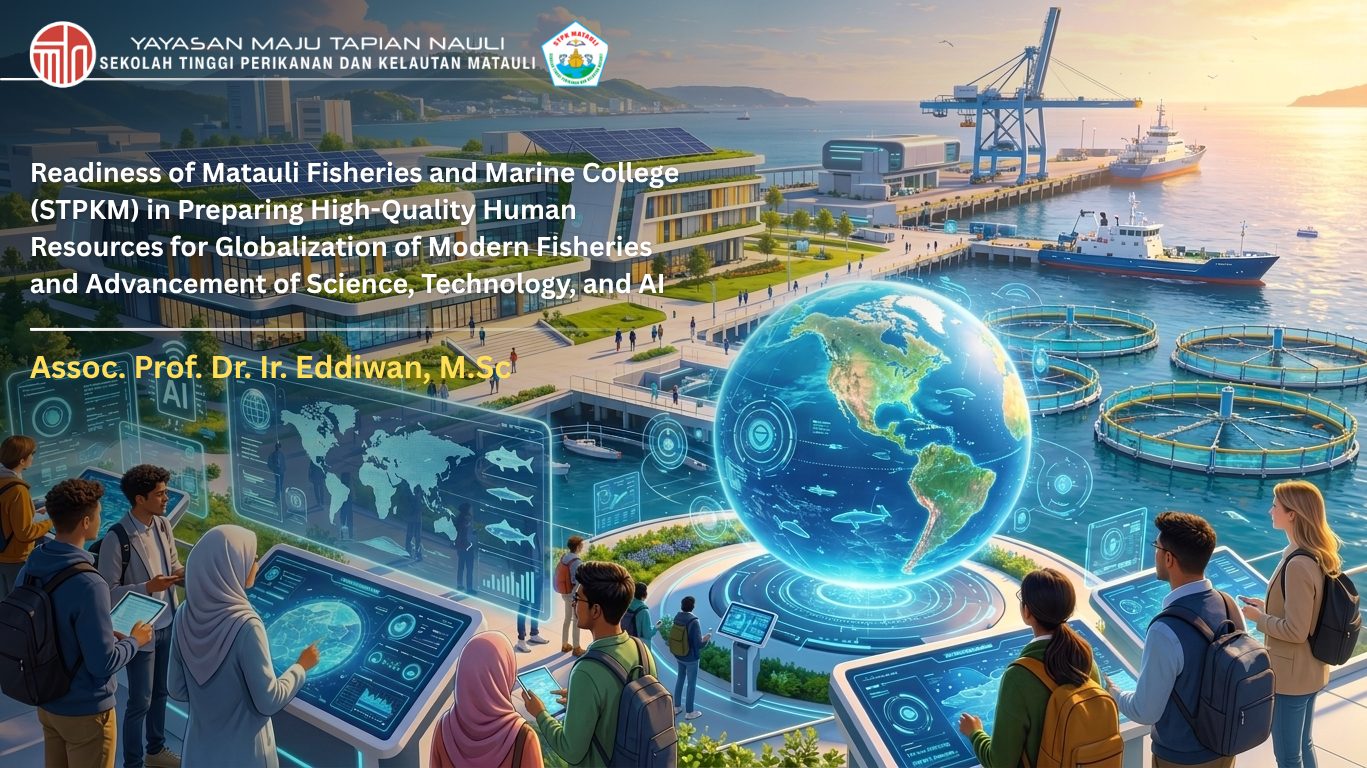
Readiness of Matauli Fisheries and Marine College (STPKM) in Preparing High-Quality Human Resources for Globalization of Modern Fisheries and Advancement of Science, Technology, and AI
Opinion · STPK Matauli
Readiness of Matauli Fisheries and Marine College (STPKM) in Preparing High-Quality Human Resources for Globalization of Modern Fisheries and Advancement of Science, Technology, and AI
Introduction
Indonesia, the world’s largest archipelago nation, possesses 5.8 million km² of marine territory and more than 17,000 islands—representing 70% of its total area. In the era of globalization and Industry 4.0, the fisheries and marine sector is no longer defined by traditional methods; it has transformed into a knowledge-intensive, technology-driven industry governed by global standards, digitalization, and artificial intelligence (AI).
Located in Pandan, Central Tapanuli, North Sumatra, Matauli Fisheries and Marine College (STPKM) stands as a strategic higher education institution in Western Sumatra. This opinion examines: how ready is STPKM to produce competent, globally competitive graduates who master modern science, technology, and AI? It analyzes curriculum, infrastructure, expert perspectives, challenges, and real-world learning cases.
I. New Demands: Globalization and Modern Fisheries Transformation
The modern fisheries industry is undergoing rapid structural change. According to the FAO (2025), the sector is shifting toward Smart and Sustainable Fisheries, built on four pillars:
- Digitalization & Remote Monitoring: satellite systems, IoT sensors, and vessel tracking
- Artificial Intelligence: predictive stock modeling, disease detection, automated feeding, and traceability
- Ecosystem-Based Management: compliance with sustainability standards
- Global Market Access: certification (MSC, ASC, HACCP) and quality assurance
Agus Trianto (2025) of Universitas Diponegoro emphasizes: “Today’s graduates must understand not only fish biology but also data analysis, digital systems, and global supply chains. Institutions that fail to adapt will produce graduates who are already obsolete.” However, Teguh Peristiwady (BRIN, 2025) adds: “AI is not a threat—it is a tool. The most in-demand professionals over the next decade will be those who combine marine science with digital literacy and data skills.”
II. STPKM’s Readiness: In-Depth Analysis
1. Curriculum Design & Competency Framework
STPKM has restructured its curriculum under the Merdeka Belajar Kampus Merdeka (MBKM) policy, aligned with national and global standards. It offers four core programs:
- Fisheries Capture Technology: focus on tuna, skipjack, and mackerel—high-value export commodities
- Aquaculture Technology: hatchery, breeding, and nutrition management
- Fisheries Product Processing: quality control and international certification
- Marine Resource Management: policy, conservation, and coastal economy
Key innovations: integration of Digital Marine Technology, GIS, Remote Sensing, and Introduction to AI from the first semester; field-based learning and internships at BRIN, PPPB, and private industries; and special modules on sustainable certification and global trade regulations. Kustiariyah Tarman (IPB University, 2025) notes: “Curriculum relevance and industry partnerships are the foundation of quality education. STPKM’s focus on high-value species and digital skills is a strong strategic choice.”
2. Infrastructure & Laboratory Support
STPKM currently operates 25+ academic facilities, including integrated labs (Aquaculture, Water Chemistry, Biotechnology, Post-Harvest Technology), hatchery units and demonstration ponds for practical training, a digital library linked to international journals and databases, and a collaboration network with 12+ institutions: USU, UNDIP, BRIN, DKP North Sumatra, and KP2MI. STPKM Strategic Plan (2026) confirms plans to develop a Marine Data & AI Laboratory to support predictive modeling and smart aquaculture research.
3. Integration of Science, Technology & AI
STPKM is systematically incorporating advanced technologies: AI & Data Analytics (modules on stock prediction, water quality modeling, and disease diagnosis), IoT & Smart Systems (introduction to automated feeding and environmental monitoring), and Digital Literacy (training in GIS, satellite imagery interpretation, and electronic reporting). UNESCO (2025) states: “Ocean literacy must cross disciplines. Merging natural science, engineering, and information technology is the only way to build resilient maritime sectors.”
4. Global Competitiveness & Certification
To prepare graduates for international labor markets, STPKM provides English proficiency programs, preparation for STCW, HACCP, and ISO certification, collaboration with KP2MI for overseas employment pathways, and a focus on Blue Economy principles and sustainable trade.
III. Expert Perspectives & Scientific Basis
Goldstein et al. (PNAS, 2022): “Technological integration improves productivity by 30–40% while reducing environmental impact. Education institutions must act as bridges between innovation and practice.” Seddon et al. (Nature Sustainability, 2024): “Fisheries professionals require dual competence: ecological understanding and digital skills. Without this combination, they cannot operate in modern global industries.” Chen et al. (Aquaculture Reports, 2025): “Universities integrating AI and digital tools show 25% higher graduate employment rates and better starting salaries.” Mukhtarudin (KP2MI, 2026): “Global employers no longer look only at diplomas—they verify competencies and certifications. STPKM’s emphasis on standards aligns with market demands.”
IV. Case Studies: Lessons & Best Practices
Case 1 · Universitas Diponegoro (UNDIP) — Smart Aquaculture & AI
Initiative: developed Smart Robotic IMTA Cages and the “Dokter Ikan” AI application for disease detection. Implementation: integrated sensors, automation, and image recognition; students involved in testing. Results: 35% higher feed efficiency, 40% lower mortality, graduates employed in high-tech aquaculture firms.
Lesson: STPKM can adopt a phased approach—start with data literacy and basic IoT, then scale up to AI systems.
Case 2 · University of Santiago, Chile — AI in Monitoring
Innovation: AI-powered camera systems to detect illegal discards and monitor vessel activity in real time. Outcome: reduced manual review time by 80%, improved compliance.
Lesson: practical integration of technology with regulatory needs increases employability and relevance.
Case 3 · Universitas Pattimura — Digital Marine Science
Strategy: established Marine AI Lab with BRIN, teaching remote sensing and habitat mapping. Impact: graduates work in conservation agencies and offshore industries.
Lesson: regional institutions can leverage national partnerships to access advanced technology without full self-investment.
V. Challenges & Strategic Recommendations
Main challenges: limited faculty expertise (need lecturers skilled in both marine science and digital/AI tools); investment costs (high-tech equipment and software require sustainable funding); continuous updates (technology evolves rapidly; curriculum must adapt annually); and data access (reliable oceanographic data remains limited in many regions).
Recommendations:
- Faculty Development: send lecturers for upskilling in data science, AI, and digital fisheries
- Public-Private Partnerships: share infrastructure costs with industry and research institutions
- Modular Learning: offer short courses in AI, IoT, and certification programs
- Applied Research: focus on local species and conditions to ensure relevance
- Monitoring & Evaluation: update competencies every two years to match industry trends
VI. Conclusion
STPKM has established a strong foundation—strategic location, relevant curriculum, growing infrastructure, and a clear vision toward modernization. To fully meet global demands, it must accelerate integration of technology, strengthen partnerships, and build a culture of innovation.
The future of Indonesia’s fisheries sector depends on quality human resources. If STPKM continues to evolve, it will not only become a center of excellence in Western Sumatra but also produce graduates who lead the transformation toward a sustainable, high-tech, and globally competitive blue economy.
References
- Chen, L., et al. (2025). Integrating Digital Technology in Fisheries Education. Aquaculture Reports, 32, 101789.
- FAO. (2025). The State of World Fisheries and Aquaculture. Rome: FAO.
- Goldstein, E. B., et al. (2022). Harnessing Island–Ocean Connections. PNAS, 119(1), e2107998118.
- Kementerian Kelautan dan Perikanan RI. (2025). National Roadmap for Fisheries Transformation 2025–2035. Jakarta: KKP.
- Mukhtarudin. (2026). Building Globally Competitive Maritime Human Resources. Jakarta: KP2MI.
- Razman, M., et al. (2020). AI Applications in Fisheries and Aquaculture: A Review. Aquaculture International, 28, 1423–1442.
- Seddon, N., et al. (2024). Technology and Sustainability in Global Fisheries. Nature Sustainability, 7(6), 458–466.
- STPKM. (2026). Strategic Plan 2026–2030: Toward Regional Excellence. Pandan: STPKM.
- STPKM. (2026). Academic Profile & Curriculum Framework. Pandan: STPKM.
- Teguh Peristiwady. (2025). The Role of AI in Marine Resource Management. Jakarta: BRIN.
- UNESCO. (2025). Ocean Literacy for All: A Global Framework. Paris: IOC.
- Universitas Diponegoro. (2025). Smart Fisheries Technology: Innovation and Application. Semarang: UNDIP Press.