Climate Change and Its Impact on Fisheries Resources in Indonesia
By Assoc. Prof. Dr. Ir. Eddiwan, M.Sc.
Head of the Matauli College of Fisheries and Marine Sciences, Pandan, Central Tapanuli Regency, North Sumatra
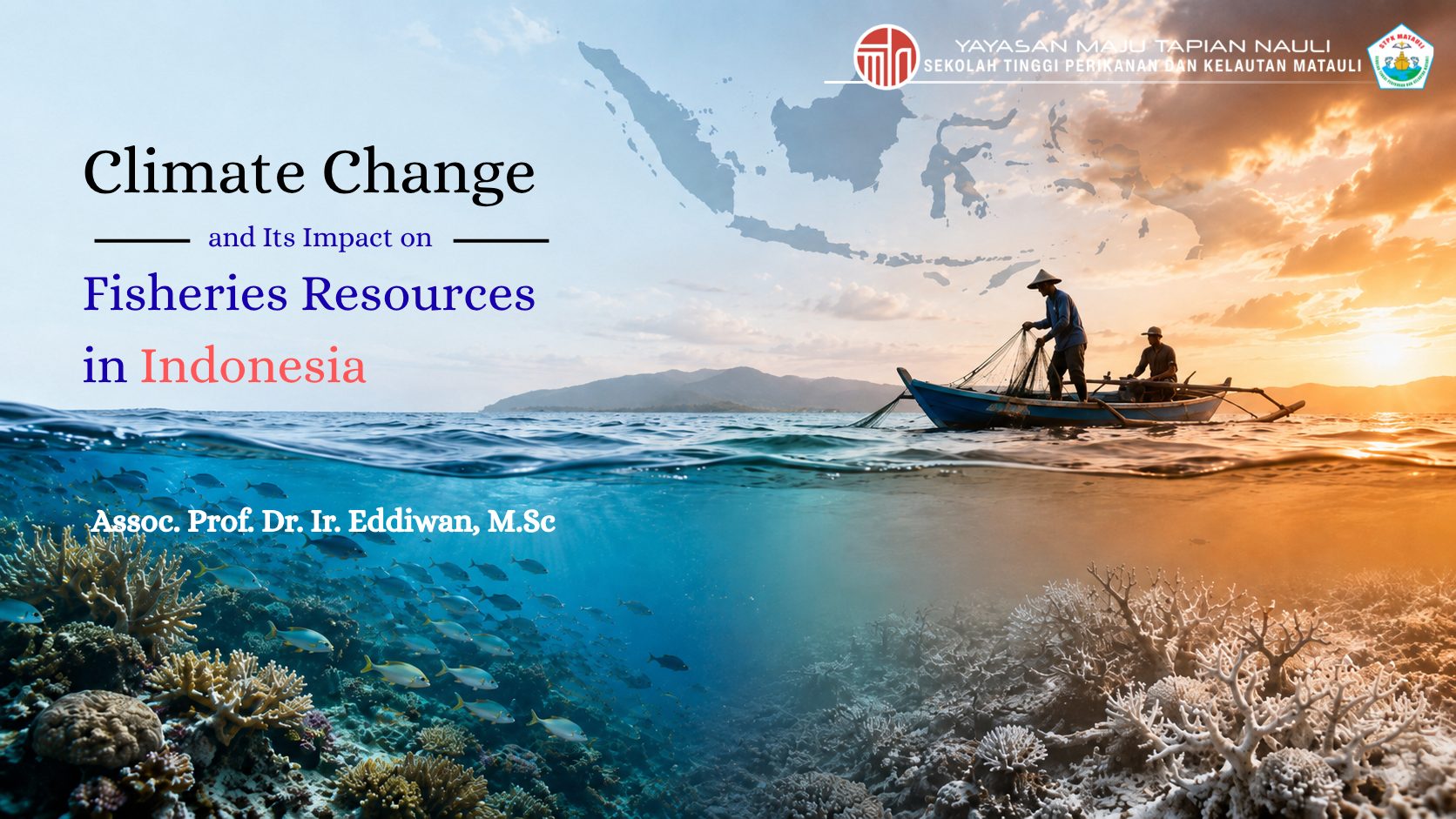
Indonesia is one of the largest maritime countries in the world, possessing enormous fisheries resources spread across marine, coastal, and inland waters. The fisheries sector plays a strategic role in national food security, employment, economic development, and the livelihoods of millions of coastal communities. However, climate change has emerged as one of the greatest threats to the sustainability of Indonesia’s fisheries resources.
Rising sea temperatures, ocean acidification, sea-level rise, changing rainfall patterns, extreme weather events, and coral bleaching are fundamentally altering marine ecosystems. These changes not only reduce fish productivity but also threaten the social and economic resilience of fishing communities throughout the archipelago. According to the Food and Agriculture Organization (FAO), climate change significantly affects fish distribution, fish productivity, trade systems, and fisheries-dependent communities worldwide.
Climate Change as a Global Ecological Crisis
Climate change refers to long-term changes in global temperature and weather patterns, primarily caused by greenhouse gas emissions from human activities such as fossil fuel combustion, deforestation, and industrialization. Marine ecosystems are highly sensitive to temperature changes. Even a slight increase in ocean temperature can disrupt fish migration patterns, coral reef ecosystems, plankton productivity, spawning cycles, and marine biodiversity.
Indonesia, located in the tropical Indo-Pacific region, is especially vulnerable because its marine biodiversity depends heavily on stable ocean temperatures. Marine scientist Daniel Pauly argues that climate change is accelerating the decline of global fisheries through ecosystem degradation and overexploitation pressures. His perspective highlights that warming oceans reduce ecosystem resilience and intensify the risk of fisheries collapse.
Major Impacts of Climate Change on Fisheries Resources
1. Rising Sea Surface Temperatures. One of the clearest impacts of climate change is increasing sea surface temperature. Warmer waters affect fish metabolism, reproductive cycles, migration routes, and oxygen availability. Many commercially important fish species migrate toward cooler waters, making traditional fishing grounds less productive. In Indonesia, fishers increasingly report unpredictable fishing seasons, declining catches, and longer fishing trips. These conditions increase fuel costs and economic uncertainty for small-scale fishers. FAO reports that climate change alters fish availability and may create major geopolitical and economic consequences for countries heavily dependent on fisheries.
2. Coral Bleaching and Coral Reef Destruction. Coral reefs are among the most important ecosystems supporting fisheries productivity in Indonesia. Coral reefs function as spawning grounds, nursery habitats, feeding areas, and biodiversity hotspots. However, rising ocean temperatures trigger coral bleaching. Coral bleaching occurs when corals expel symbiotic algae due to thermal stress, causing reefs to lose color and eventually die if stress persists.
Research conducted in Gili Matra, West Nusa Tenggara, showed severe coral bleaching during the 2016 warming event caused by elevated sea surface temperatures. A recent study in West Lombok also documented significant coral bleaching linked to climate anomalies and El Niño events. The consequences for fisheries are profound: declining reef fish populations, habitat loss, reduced biodiversity, and lower fishery productivity. A study from Raja Ampat demonstrated that coral degradation can fundamentally alter fish communities and reduce fisheries production.
Case Study: Coral Bleaching in Bali
In northern Bali, conservationists observed devastating bleaching events linked to rising sea temperatures. Reuters reported that approximately 90% of coral reefs near Bondalem experienced bleaching during extreme warming conditions associated with climate change and El Niño. This situation threatens reef fisheries, marine tourism, coastal protection, and local livelihoods. The case illustrates how climate change simultaneously impacts ecology and the economy.
3. Declining Fish Stocks and Biodiversity. Climate change also disrupts marine food webs. Changes in temperature and ocean chemistry influence plankton productivity, which forms the foundation of marine ecosystems. When lower trophic levels decline, higher trophic species such as tuna, mackerel, and reef fish are also affected. Research indicates that long-term coral bleaching changes fish assemblages permanently. Large predatory fish decline while algae-associated species increase. This ecological shift threatens Indonesia’s fisheries sustainability because economically valuable species may become less abundant.
4. Extreme Weather and Fishing Risks. Climate change intensifies storms, high waves, flooding, and unpredictable weather patterns. For Indonesia’s small-scale fishers, this creates dangerous working conditions. Fishing trips become shorter, riskier, and less productive. Many fishers experience income instability, equipment damage, and increased operational costs. Studies on climate vulnerability in small-scale fisheries show that changing weather patterns significantly reduce catch-per-unit effort (CPUE) and household income.
5. Impacts on Coastal Communities and Food Security. Indonesia’s coastal communities are highly dependent on fisheries resources for food, employment, and cultural identity.
Climate change threatens this socio-economic foundation. Research on Indonesian small-scale fisheries found that climate change adaptation strongly influences fisher income and household food security. When fish catches decline, protein consumption decreases, poverty increases, and migration pressures rise. This creates a cycle of social vulnerability that may destabilize coastal regions.
Economic Implications
The fisheries sector contributes significantly to Indonesia’s economy. Climate change threatens fish exports, aquaculture productivity, seafood processing industries, and tourism sectors linked to marine ecosystems. Coral reef degradation alone may cause billions of dollars in economic losses through reduced fisheries yields, lower tourism revenue, and weakened coastal protection. The long-term economic costs may exceed adaptation investments if mitigation measures are delayed.
Climate Change and Aquaculture
Aquaculture is often viewed as a solution to declining capture fisheries. However, aquaculture itself is vulnerable to climate change. Major risks include rising water temperature, disease outbreaks, salinity changes, and extreme rainfall. Shrimp farming and fish ponds in coastal Indonesia are particularly sensitive to sea-level rise, flooding, and water quality deterioration. Without adaptive management, aquaculture productivity may also decline significantly.
Adaptation Strategies for Indonesia
To protect fisheries resources, Indonesia must strengthen climate adaptation and sustainable marine management.
- Ecosystem-Based Fisheries Management. Management should integrate biodiversity conservation, habitat restoration, and sustainable harvesting.
- Coral Reef Rehabilitation. Programs such as reef restoration and marine protected areas are essential.
- Climate-Resilient Aquaculture. Developing resilient aquaculture systems can reduce vulnerability.
- Early Warning Systems. Improved weather forecasting helps fishers reduce risks at sea.
- Diversification of Livelihoods. Alternative income sources can strengthen coastal resilience.
- Reduction of Greenhouse Gas Emissions. Global mitigation efforts remain essential because adaptation alone is insufficient.
Expert Perspectives
According to the FAO, fisheries and aquaculture sectors require urgent adaptation measures because climate change threatens fish availability, trade, and food security globally. Coral reef experts warn that repeated marine heatwaves may permanently transform tropical marine ecosystems if global warming continues. Researchers studying Indonesian fisheries emphasize that adaptation policies must focus on small-scale fishing communities because they are among the most vulnerable populations.
Conclusion
Climate change represents a multidimensional threat to Indonesia’s fisheries resources. Rising ocean temperatures, coral bleaching, biodiversity loss, extreme weather, and declining fish productivity are already affecting marine ecosystems and coastal livelihoods throughout the country. Indonesia’s fisheries future depends on the ability to integrate sustainable fisheries management, ecosystem conservation, climate adaptation, and international climate action. If climate change is not addressed seriously, Indonesia risks losing not only marine biodiversity but also food security, economic stability, and the cultural heritage of its coastal communities. Conversely, strong adaptation policies, scientific innovation, and sustainable governance can help Indonesia build resilient fisheries systems capable of facing future climate challenges.