Positioning STPK Matauli and Its Graduates in Advancing the Blue Economy toward Golden Indonesia 2045
News · STPK Matauli
Positioning STPK Matauli and Its Graduates in Advancing the Blue Economy toward Golden Indonesia 2045
Pandan, Central Tapanuli · Thursday, 9 July 2026
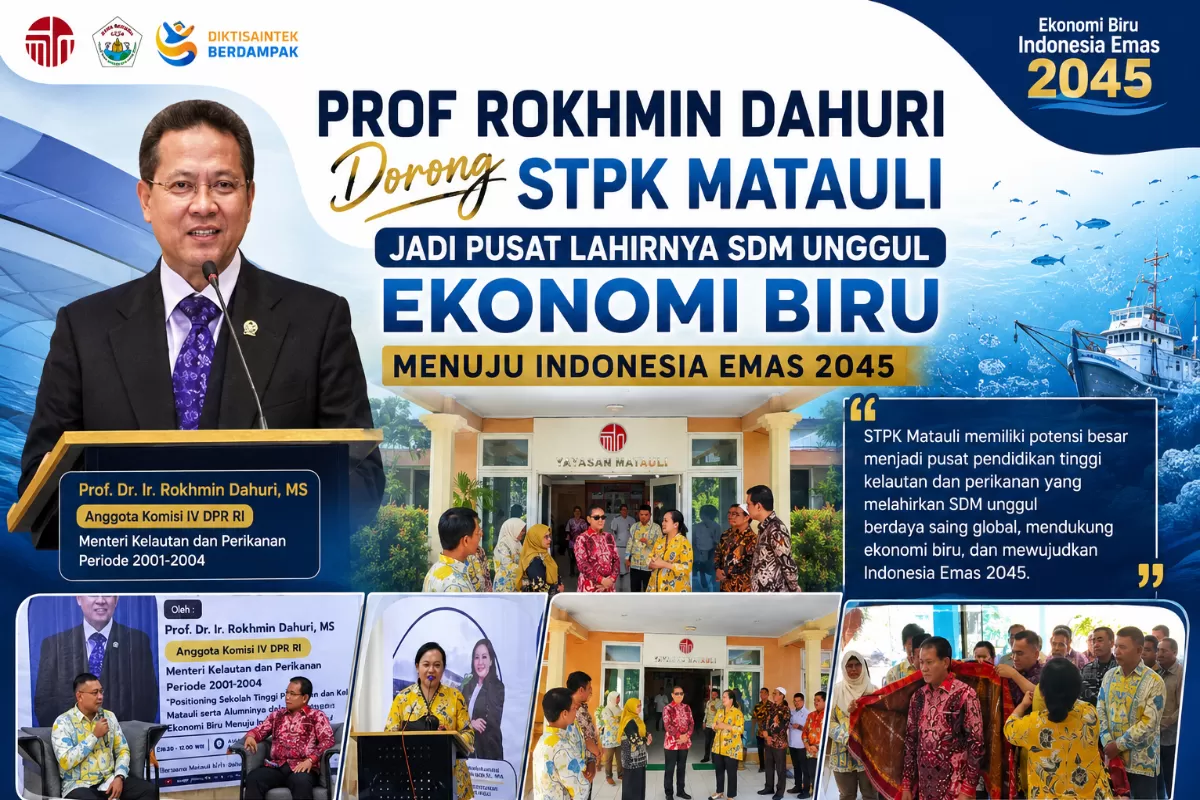
Pandan, Central Tapanuli — Member of Commission IV of the House of Representatives of the Republic of Indonesia, former Minister of Marine Affairs and Fisheries (2001–2004), and Professor of Marine Sciences, Prof. Dr. Ir. Rokhmin Dahuri, M.S., delivered the keynote address at the Studium Generale STPK Matauli 2026, entitled “Positioning Sekolah Tinggi Perikanan dan Kelautan Matauli serta Alumninya dalam Pembangunan Ekonomi Biru Menuju Indonesia Emas 2045.”
The event was organized by Sekolah Tinggi Perikanan dan Kelautan (STPK) Matauli under the leadership of Dr. Ir. H. Akbar Tandjung (Chairman of the Matauli Foundation Board of Trustees), Triana Krisandini Tandjung, B.Sc., MIA (Chairperson of the Matauli Foundation), and Dr. Ir. Eddiwan, M.Sc. (Chairman of STPK Matauli), bringing together lecturers, students, alumni, government officials, and stakeholders from Indonesia’s marine and fisheries sector.
Central Tapanuli, a Foundation for the Blue Economy
In his keynote address, Prof. Rokhmin emphasized that Indonesia’s abundant marine resources, strategic geographic position, and status as the world’s largest archipelagic nation provide an extraordinary foundation for sustainable development.
Three Strategic Development Priorities
Prof. Rokhmin outlined three strategic priorities for the region’s development:
- Sustainable capture fisheries
- Marine aquaculture — particularly high-value commodities such as lobster and seaweed
- Downstream fish processing industries to increase value added, strengthen export competitiveness, and expand employment opportunities
11 Strategic Sectors of the Marine Economy
He further explained that Indonesia’s marine economy comprises 11 strategic sectors:
Developed through science, technology, innovation, downstream industrialization, and good governance, these sectors can become powerful engines of economic growth, food security, poverty reduction, job creation, and national competitiveness.
Local Government Commitment
Regent of Central Tapanuli, Masinton Pasaribu, reaffirmed his commitment to strengthening collaboration among the central government, local government, universities, and the private sector to accelerate blue economy implementation. This collaboration is expected to improve the welfare of local communities and business actors while supporting the broader vision of Golden Indonesia 2045.
Pentahelix Collaboration
Prof. Rokhmin concluded that this transformation requires strong pentahelix collaboration among government, academia, the private sector, communities, and the media, with STPK Matauli and its alumni serving as future leaders, innovators, and agents of change—transforming Indonesia’s maritime potential into sustainable prosperity, strengthening national sovereignty, and enhancing Indonesia’s competitiveness on the global stage.