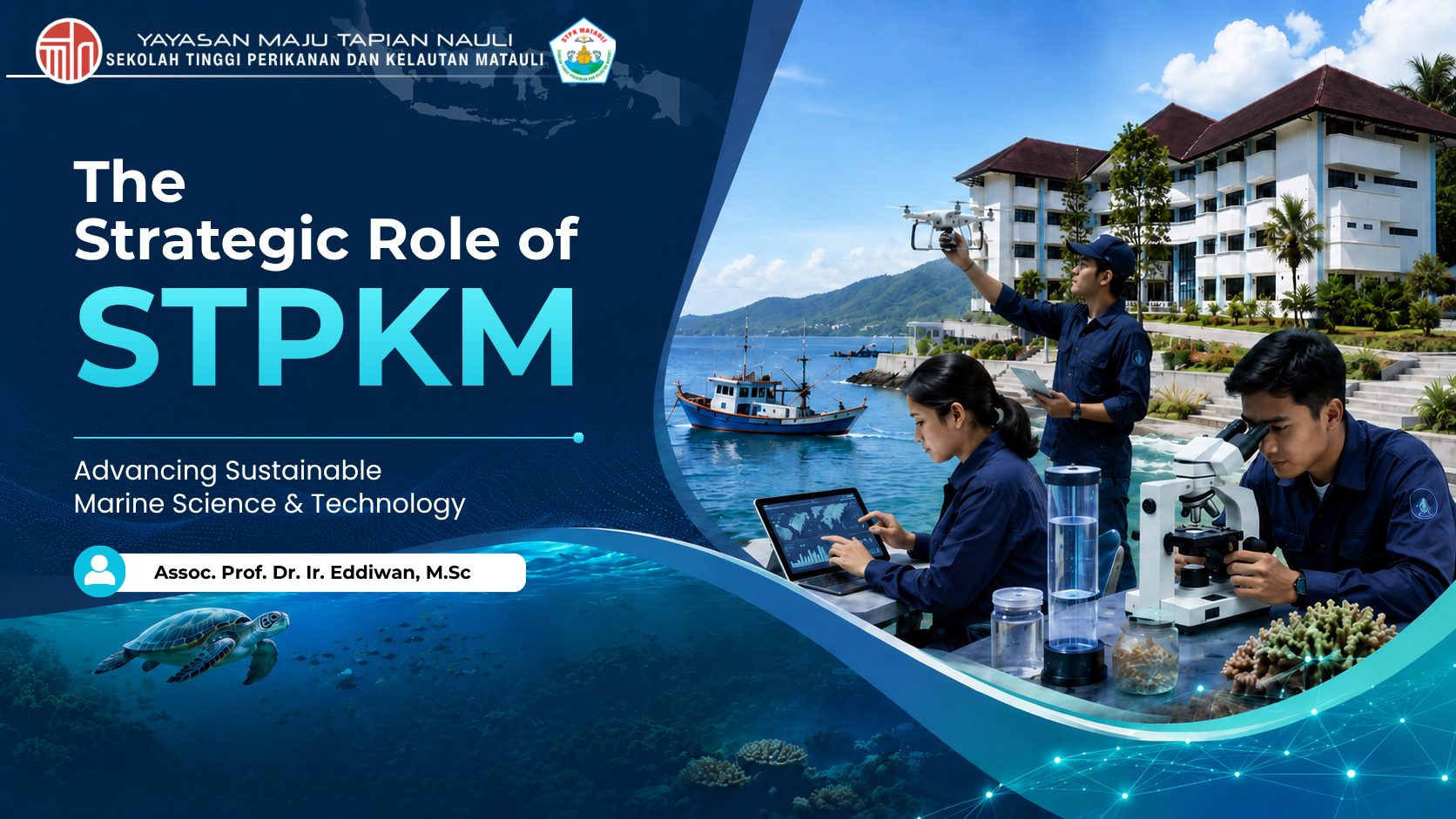
The Strategic Role of Matauli Fisheries and Marine College (STPKM) in Advancing Sustainable Marine Science and Technology for Indonesia’s Future Prosperity
By Assoc. Prof. Dr. Ir. Eddiwan, M.Sc
Head of Matauli Fisheries and Marine College
Tapanuli Tengah District, North Sumatra.
Abstract
The establishment and development of the Matauli Fisheries and Marine College (STPKM) represent a strategic academic and national investment in strengthening Indonesia’s maritime capacity. Drawing on contemporary scientific discourse from international journals and global institutional reports, this opinion argues that higher education institutions such as STPKM play a pivotal role in bridging science, technology, and policy in sustainable fisheries and marine resource management. The integration of ecosystem-based approaches, technological innovation, and community empowerment is essential to achieving Indonesia’s long-term goals of economic resilience, environmental sustainability, and global maritime leadership.
Introduction: Indonesia and the Imperative of Marine Excellence
Indonesia, as the world’s largest archipelagic nation, possesses unparalleled marine biodiversity and fisheries potential. However, this potential is accompanied by complex challenges, including overfishing, climate change, and governance gaps. The development of institutions like STPKM must therefore be viewed not merely as educational expansion, but as a cornerstone of national transformation toward a sustainable blue economy.
According to the Food and Agriculture Organization, fisheries are central to global food systems, with sustainable aquatic food systems contributing to “better production, better nutrition, a better environment, and a better life.” This perspective underscores the strategic importance of fisheries education in shaping future leaders capable of managing marine resources responsibly.
Higher Education as a Catalyst for Marine Science and Technology
The role of higher education institutions in advancing marine science is globally recognized. UNESCO emphasizes that “sustainable ocean management is dependent on humanity’s capacity to develop ocean science”. This statement reflects a fundamental truth: scientific knowledge is the backbone of sustainable marine governance. In this context, STPKM can serve as a center of excellence by integrating: marine biotechnology, fisheries resource modeling, oceanographic data systems, and digital fisheries (AI, IoT, remote sensing). Such integration aligns with recent scientific findings that highlight the need to connect scientific research with governance frameworks to ensure effective fisheries management. Moreover, experiential and field-based learning—advocated in global ocean education initiatives—demonstrates that students equipped with real-world ecological understanding are more capable of developing innovative conservation solutions.
Sustainable Fisheries: The Scientific and Ethical Foundation
Sustainability is no longer optional—it is a scientific and moral imperative. Global literature consistently emphasizes that fisheries must balance ecological integrity with socio-economic needs. A widely accepted definition states that sustainable fisheries are those that “respect habitats, protect fish stocks, and support livelihoods”. This holistic approach aligns with ecosystem-based fisheries management (EBFM), which integrates ecological, economic, and social dimensions. Furthermore, research indicates that sustainably managed fisheries enhance food security, stabilize coastal economies, and promote inclusive growth. As one synthesis of global fisheries policy notes, “well-managed fisheries can contribute to poverty eradication and economic well-being”. Thus, STPKM’s academic orientation must embed sustainability not only as a subject, but as a core institutional philosophy.
Bridging Science, Policy, and Community
One of the major global challenges identified in recent literature is the disconnect between scientific knowledge and policy implementation. A 2026 study in the Journal of Cleaner Production highlights that fisheries governance often fails to integrate the latest scientific findings effectively. STPKM can address this gap through: policy-oriented research, collaboration with government and regional fisheries bodies, and community-based participatory management. The FAO underscores the importance of regional cooperation, stating that “regional fisheries bodies are essential to advancing fisheries sustainability”. Additionally, universities have proven their role in community empowerment. For example, academic programs that train fishers in sustainable practices demonstrate how science can directly improve livelihoods and biodiversity conservation.
Technology and Innovation: Toward a Modern Maritime Industry
The future of fisheries lies in technological transformation. Modern marine industries increasingly rely on: satellite-based monitoring systems, big data analytics for stock assessment, smart aquaculture technologies, and renewable ocean energy systems. However, global reports note that many developing countries still lag in adopting these technologies due to limited capacity. This is where STPKM becomes crucial—as a technology incubator that produces skilled human resources capable of driving innovation. The transformation toward a “Blue Economy” requires not only natural resources but also knowledge capital and technological capability.
Toward National Prosperity and Maritime Glory
The long-term vision of STPKM aligns with Indonesia’s aspiration to become a global maritime axis. Sustainable fisheries are not merely an environmental concern; they are a pillar of national development. Globally, more than 3 billion people depend on seafood as a primary protein source, highlighting the strategic importance of fisheries in food security. For Indonesia, this translates into economic growth through fisheries exports, employment generation in coastal communities, and strengthening national food sovereignty. As FAO and global experts emphasize, transforming aquatic systems is “not only necessary but already underway”. Indonesia must not lag behind.
Conclusion: STPKM as a Strategic Pillar of the Future
The development of Matauli Fisheries and Marine College (STPKM) is not merely an institutional milestone—it is a national strategic imperative. In an era defined by environmental uncertainty and technological disruption, the future of Indonesia’s marine sector depends on its ability to generate cutting-edge scientific knowledge, integrate sustainability into all aspects of resource management, produce globally competitive human resources, and bridge science, policy, and society. In the words of global ocean governance discourse, sustainable ocean management is essential for “climate, biodiversity, and economic resilience”. Therefore, STPKM stands as a beacon of hope—an academic institution capable of transforming Indonesia’s vast marine wealth into sustainable prosperity and enduring national glory.
References
FAO (2025). Sustainable fisheries and aquaculture reports.
UNESCO (2023–2025). Ocean science and sustainability frameworks.
Journal of Cleaner Production (2026). Sustainable fisheries governance.
FAO Symposium on Fisheries Sustainability (2019).
Peer-reviewed studies on sustainable fisheries and coastal development.